Discover 20+ small business tax deductions most owners miss in 2025, including home office, vehicle, meals, and software. Real examples and dollar figures included.
The Small Business Tax Deductions Checklist for 2025
Every dollar you fail to deduct is a dollar you overpay to the IRS. The small business tax deductions list is longer than most owners realize, and the gap between what you can deduct and what you actually deduct often runs into thousands of dollars per year. This guide covers 20-plus deductions, how to calculate them correctly, and the specific scenarios where business owners routinely leave money on the table.
Key Takeaways
- The home office deduction allows up to $1,500 per year using the simplified method, or potentially far more using the regular method based on actual expenses.
- The Section 179 deduction lets small businesses deduct up to $1,160,000 in equipment costs in a single tax year (2025 limit, subject to IRS confirmation).
- Self-employed business owners can deduct 100% of health insurance premiums paid for themselves, their spouse, and dependents.
- The IRS standard mileage rate for 2025 is 67 cents per mile, meaning a freelancer who drives 10,000 business miles saves $670 in deductions alone.
- Meals with clients or business partners are 50% deductible, but only when a clear business purpose is documented at the time of the meal.
Why Most Owners Miss Deductions on the Small Business Tax Deductions List
The problem is not awareness. Most business owners know deductions exist. The problem is documentation, categorization, and timing. A deduction you cannot prove is a deduction you cannot take. The IRS requires that each expense be ordinary (common in your industry) and necessary (helpful and appropriate for your business).
Here is why that matters: "ordinary and necessary" is broader than most people think. A photographer can deduct a camera lens. A consultant can deduct a LinkedIn Premium subscription. A food blogger can deduct restaurant meals. The deduction is real as long as the business purpose is real and documented.
Home Office Deduction
The Two Calculation Methods
The home office deduction is one of the most misunderstood items on any small business tax deductions list. You must use the space regularly and exclusively for business. A desk in the corner of your living room where your kids also do homework does not qualify.
Simplified Method: Deduct $5 per square foot, up to 300 square feet, for a maximum deduction of $1,500 per year.
Regular Method: Calculate the percentage of your home used for business (home office square footage divided by total home square footage), then apply that percentage to actual home expenses including rent or mortgage interest, utilities, repairs, and insurance.
In practice, a business owner renting a 1,200-square-foot apartment with a 150-square-foot dedicated office, paying $2,400 per month in rent, would qualify for a 12.5% deduction. That comes out to $3,600 per year, more than double the simplified method ceiling.
Vehicle and Mileage Deductions
Standard Mileage vs. Actual Expenses
Vehicle deductions are worth tracking from January 1. At 67 cents per mile for 2025, the math adds up fast. A real estate agent driving 20,000 business miles per year generates a $13,400 deduction using the standard mileage rate, with no need to track fuel receipts or oil changes separately.
The actual expense method tracks gas, insurance, depreciation, registration, and maintenance, then applies the business-use percentage to the total. This method sometimes yields a larger deduction for high-cost vehicles or owners who do not drive as many miles but have significant vehicle expenses.
You cannot switch freely between methods. If you use the standard mileage rate in year one, you lock in that approach for the life of that vehicle. Choose carefully, and use a mileage log app like MileIQ or Everlance to document every trip in real time.
Equipment and Technology: Section 179 and Bonus Depreciation
Deduct the Full Cost in Year One
Under Section 179, a small business can deduct the full purchase price of qualifying equipment in the year it is placed in service. The 2025 deduction limit sits at $1,160,000, which covers nearly every small business purchase imaginable, from computers and printers to machinery and office furniture.
Consider Marcus Chen, who runs a small video production company in Austin, Texas. In 2024, Marcus purchased a camera kit for $8,500, a MacBook Pro for $2,400, and editing software for $600. Using Section 179, he deducted the full $11,500 in the same tax year, rather than depreciating the equipment over five to seven years. At a 22% federal tax rate, that single decision saved him approximately $2,530 in federal taxes.
Bonus depreciation, which is being phased down, allowed 60% first-year depreciation in 2024. Check IRS Publication 946 for the current phase-out schedule as you plan 2025 purchases.
Software, Subscriptions, and Digital Tools
This category is where freelancers and service businesses consistently leave money unclaimed. Any software or subscription used primarily for business is deductible.
Common examples include accounting software like QuickBooks or FreshBooks, project management tools like Asana or Monday.com, cloud storage like Dropbox or Google Workspace, design tools like Adobe Creative Cloud, and scheduling tools like Calendly or Acuity.
A solopreneur paying $50 per month each for five tools is spending $3,000 per year. That full amount is a legitimate business deduction, saving roughly $660 at a 22% tax rate. Most business owners have already paid for these tools. The only step left is categorizing them correctly.
Meals and Entertainment
The 50% Rule and How to Document It
Client meals are 50% deductible when the meal has a direct business purpose and you are present. The IRS killed the entertainment deduction in 2018, so concert tickets, sporting events, and golf rounds are no longer deductible, even when clients are present.
What still works: a lunch where you discuss a proposal, a dinner with a new vendor, or a coffee meeting with a referral partner. Write the business purpose on the receipt the same day. Note who attended. Keep the receipt, not just the credit card statement.
A sales consultant who spends $4,800 per year on client dinners deducts $2,400 after the 50% haircut. That translates to $528 in tax savings at the 22% rate. Small per-meal amounts compound into real annual savings.
Health Insurance Premiums
Self-employed business owners who are not eligible for employer-sponsored health insurance can deduct 100% of premiums paid for themselves, their spouse, and their dependents. This deduction is taken on Schedule 1 of Form 1040, not on Schedule C, which means it reduces adjusted gross income regardless of whether you itemize.
For a sole proprietor paying $600 per month in premiums, that is $7,200 per year in deductions. At a combined federal and state effective rate of 30%, the tax savings reach $2,160 annually.
Other Deductions Most Owners Miss on the Small Business Tax Deductions List
Retirement Contributions
A SEP-IRA allows contributions up to 25% of net self-employment income, with a 2025 cap of $69,000. A freelance consultant earning $120,000 net can contribute and deduct up to $30,000, dramatically reducing taxable income.
Business Insurance
General liability, professional liability (errors and omissions), commercial property, and business interruption insurance are all fully deductible. If you pay $2,400 per year in premiums, that is $2,400 off your taxable income.
Professional Development and Education
Courses, certifications, books, and workshops are deductible when they maintain or improve skills required in your current business. A graphic designer taking a $500 typography course qualifies. A graphic designer taking a $500 real estate licensing course does not, because it trains for a new profession.
Bank Fees and Merchant Processing Fees
Stripe charges 2.9% plus 30 cents per transaction. On $100,000 in annual revenue, that is roughly $3,200 in fees. Every cent is deductible. The same applies to monthly business checking fees, wire transfer fees, and PayPal charges.
Contractor and Freelancer Payments
Payments to subcontractors are fully deductible as a business expense. If you pay contractors $1,000 or more in a calendar year, you are required to issue a 1099-NEC. Missing this form does not eliminate your deduction, but it can trigger penalties.
Phone and Internet
If you use your phone and internet for business, the business-use percentage is deductible. Most business owners deduct 50% to 80% depending on documented usage. On a $150 monthly phone bill, an 80% business-use rate yields a $1,440 annual deduction.
How to Put This Into Practice Before Tax Season
Start a dedicated folder, physical or digital, for every receipt. Reconcile your business accounts monthly rather than once a year in April. Use accounting software to categorize expenses in real time so nothing slips through.
If you work with a CPA or tax preparer, come organized. The more clearly you present your expenses, the less time your preparer spends reconstructing records, and the less you pay in preparation fees.
Save Time With a Tax Prep Checklist
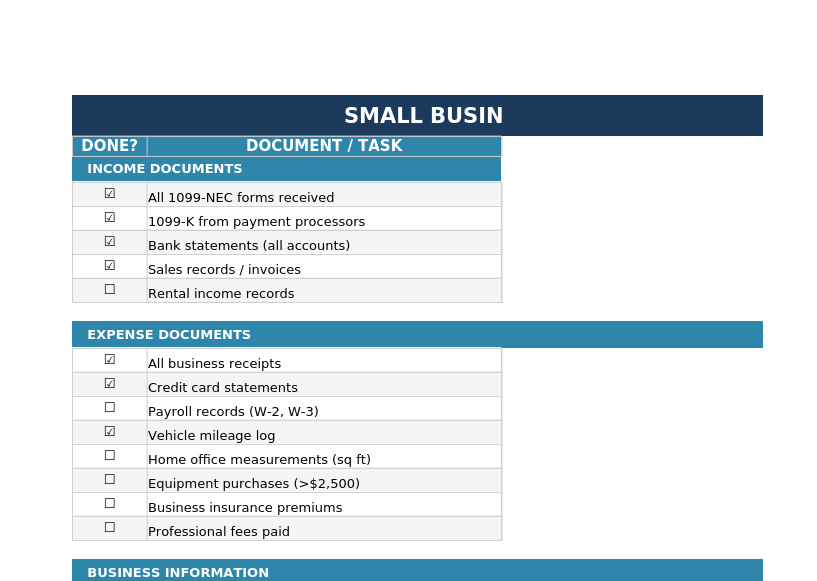
If this post gave you a clearer picture of what you can deduct, the next step is making sure you have everything in order before you sit down with your preparer or open your tax software. The Tax Prep Checklist template covers every category in this guide, with a line-by-line format you can fill out as you gather documents. At $9, it costs less than one hour of a bookkeeper's time and can save several hours of back-and-forth during filing season.
What the Template Looks Like
Here is a preview of the Tax Prep Checklist with sample data filled in:
The Bottom Line
The small business tax deductions list available to owners in 2025 is extensive, and most of the missed savings come from poor documentation rather than missing deductions. Tracking mileage, categorizing software expenses, and filing home office calculations correctly can collectively reduce taxable income by $10,000 or more for a typical small business. Start with the categories covered here, document everything in real time, and revisit your deduction strategy quarterly rather than waiting until April.