Learn how small business cash flow management works, why profitable businesses still fail, and how to track all three cash flow types every month.
Small Business Cash Flow Management: The Complete Guide
Cash flow is not a synonym for profit. That distinction confuses more small business owners than almost any other concept in finance, and it costs some of them their businesses entirely. Small business cash flow management is the practice of tracking, forecasting, and controlling the actual movement of money into and out of your business, regardless of what your income statement says.
This guide explains how it works, why it fails even for profitable businesses, and what a reliable monthly system looks like.
Key Takeaways
- 82% of small business failures are caused by poor cash flow management, according to a U.S. Bank study
- A business can show net profit on its income statement and still run out of cash to pay its bills
- There are three distinct types of cash flow: operating, investing, and financing, and each tells a different story
- Businesses with 30-to-60-day invoice payment terms can face cash gaps of $10,000 or more even during strong revenue months
- A consistent monthly cash flow tracking system can identify shortfalls 30 to 90 days before they become crises
What Cash Flow Actually Means
Cash flow is the net amount of cash moving in and out of your business during a specific period. Money coming in from customers is a cash inflow. Money leaving to pay rent, payroll, suppliers, or loan payments is a cash outflow. The difference between the two is your net cash flow for that period.
Here is why that matters: cash flow is measured on a cash basis, not an accrual basis. If you invoice a client $8,000 in March but they pay in May, that $8,000 does not appear in your March cash flow. Your accountant may record it as March revenue, but your bank account tells a different story.
This timing gap is where businesses get into serious trouble.
The Difference Between Cash Flow and Profit
Profit is revenue minus expenses, as recorded on your income statement. Cash flow is the actual dollars available in your account at any given time. These two numbers are often very different, sometimes dramatically so.
A construction company might complete $200,000 worth of projects in a quarter and still be unable to make payroll if clients have not paid their invoices yet. The profit is real. The cash is not there yet. That gap is a cash flow problem, not a profitability problem.
Why Profitable Businesses Still Run Out of Cash
This is the scenario that blindsides small business owners most often. The books look good. Revenue is up. The owner is reinvesting in the business. And then one Tuesday, payroll is due and the bank account comes up short.
The Invoice Timing Problem
Consider a real-world example. Sarah Chen owns a mid-sized marketing agency called Brightline Creative in Austin, Texas. Her agency generates $480,000 in annual revenue, which works out to about $40,000 per month. Her monthly operating costs, including payroll for five employees, software, and rent, total $31,000. On paper, she is making $9,000 per month.
The problem: Brightline operates on net-30 payment terms, and two of her largest clients routinely pay at day 45 or 50. In any given month, Sarah may have $22,000 of earned revenue sitting unpaid. Meanwhile, her $31,000 in expenses does not wait. She has to cover the gap herself, usually by drawing from a business line of credit that costs her 9.5% annually.
Sarah is profitable. She is also, structurally, cash flow negative several months per year.
Rapid Growth Can Drain Cash Fast
Growth is one of the most underappreciated causes of cash flow problems. When a business lands a large new contract, it often has to spend money immediately, hiring staff, buying inventory, or covering upfront costs, before any revenue arrives from that contract.
A retailer that increases inventory by $50,000 to prepare for a busy season has drained $50,000 in cash, even if the products sell within 60 days. The cash gap between spending and collecting is a structural feature of growth, not a sign that something is wrong.
The Three Types of Cash Flow Every Business Owner Should Know
Your cash flow statement divides all cash activity into three categories. Understanding each one changes how you interpret your financial picture.
1. Operating Cash Flow
Operating cash flow covers the day-to-day cash generated or consumed by your core business activities. It includes cash received from customers, cash paid to suppliers, payroll, rent, utilities, and other routine expenses.
This is the most important number for most small businesses. Positive operating cash flow means your business generates enough cash from its actual operations to sustain itself. Negative operating cash flow, even temporarily, means you are burning reserves or borrowing to fund normal operations.
2. Investing Cash Flow
Investing cash flow reflects money spent on, or received from, long-term assets. Purchasing equipment, buying a vehicle for the business, or selling a piece of property all show up here.
Investing cash flow is often negative for growing businesses, and that is not necessarily a bad sign. Spending $25,000 on new equipment that will generate revenue for the next seven years is a sound decision. The key is making sure that investment does not starve your operating cash flow in the short term.
3. Financing Cash Flow
Financing cash flow captures money that moves between your business and its lenders or owners. Taking out a $50,000 SBA loan is a cash inflow in this category. Repaying that loan is a cash outflow. Owner draws and dividend payments also appear here.
Financing cash flow helps you understand how dependent your business is on outside capital to fund operations. If your financing cash flow is consistently positive because you keep drawing on credit lines to cover expenses, that is a signal worth examining.
How to Build a Monthly Cash Flow Management System
Tracking cash flow does not require an accounting degree. It requires consistency and a clear structure. The following system works for businesses with $100,000 to $5 million in annual revenue.
Step 1: Reconcile Your Bank Accounts Weekly
Every week, match your bank statement transactions to your records. Do not wait until month-end. Weekly reconciliation catches errors early and gives you a real-time picture of your cash position, not a 30-day-old one.
Step 2: Build a 13-Week Cash Flow Forecast
A 13-week forecast covers roughly one quarter. For each week, list your expected cash inflows based on when invoices are actually likely to be paid, not when they are issued. Then list all confirmed outflows: payroll dates, rent due dates, loan payments, and vendor terms.
The gap between those two numbers is your projected cash position at the end of each week. A forecast like this lets you see a cash shortfall 60 days before it happens, when you still have time to collect on invoices, delay a purchase, or arrange credit.
Step 3: Track Receivables Aging Every Month
Receivables aging tells you how long your outstanding invoices have been unpaid. Categorize them by 0 to 30 days, 31 to 60 days, and 61 to 90-plus days. Any invoice past 60 days needs active follow-up.
If 30% or more of your receivables are sitting past 45 days, your payment terms or collection process needs adjustment. Many businesses solve this by offering a 2% early payment discount for invoices paid within 10 days, a strategy that can meaningfully improve cash timing.
Step 4: Review Actual vs. Projected Cash Flow Monthly
At the end of each month, compare what you forecasted to what actually happened. Where did cash come in later than expected? Where did costs exceed projections? This review is how your forecasting gets more accurate over time, and how you catch patterns before they become problems.
Common Small Business Cash Flow Mistakes
Even business owners who understand cash flow conceptually make avoidable errors in practice.
- Confusing revenue with cash: Recording a sale and receiving payment are two different events. Never make financial decisions based on pending invoices.
- Ignoring seasonal patterns: If your business slows down every January, your cash flow plan should account for that by building reserves in Q4.
- Skipping the forecast: A forecast does not have to be perfect to be useful. An imperfect 13-week projection is still more valuable than no projection at all.
- Delaying invoices: Every day you wait to send an invoice is a day added to how long it takes to get paid. Invoice immediately upon delivery of goods or services.
- Mixing personal and business finances: This makes it nearly impossible to get an accurate read on business cash flow. Separate accounts are non-negotiable.
A Simpler Way to Track It All
If building a cash flow system from scratch sounds like a project you will keep postponing, a pre-built tool removes most of the friction.
The Cash Flow Tracker template at tdniverse3.gumroad.com/l/wunkt ($12) gives you a ready-to-use monthly tracking spreadsheet built around everything covered in this guide. It includes the 13-week forecast structure, a receivables aging tracker, and an actual-vs-projected comparison tab. You enter your numbers and the structure does the rest.
For $12, it saves the three to five hours most business owners spend building something similar from scratch, usually less accurately.
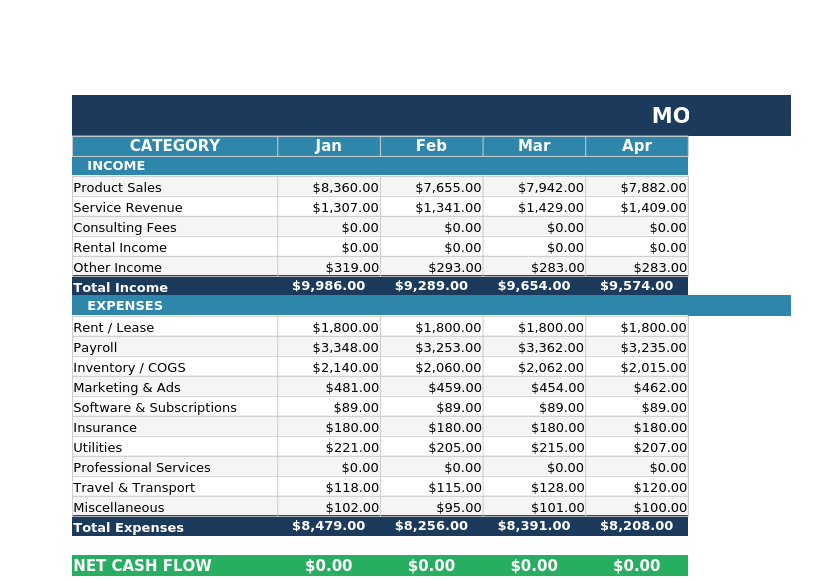
What the Template Looks Like
Here is a preview of the Cash Flow Tracker with sample data filled in:
The Bottom Line
Small business cash flow management is not about how much you earn. It is about when money arrives, when it leaves, and whether you have enough in between to keep operating. Profitable businesses fail because of cash timing problems, not because the business model is broken. A consistent monthly system, anchored by a reliable forecast and a weekly bank review, is the most practical way to stay ahead of shortfalls before they become emergencies.