Side hustle taxes explained: learn what you owe on self-employment income, which expenses to deduct, and how to estimate your tax bill before filing.
Side Hustle Taxes: What You Owe and How to Prepare
Side hustle taxes catch most people off guard the first time they file. You earned extra income, you enjoyed the flexibility, and then April arrives and you discover the IRS wants a significant cut — plus a tax you may have never heard of before. Understanding how self-employment tax works, which deductions you can legitimately claim, and how to estimate what you owe before filing will save you from scrambling for cash at the worst possible time.
Key Takeaways
- Any net self-employment income above $400 triggers a filing requirement with the IRS, regardless of your regular W-2 income.
- Self-employment (SE) tax is 15.3% on net earnings, covering Social Security (12.4%) and Medicare (2.9%), and it applies before federal income tax is even calculated.
- Freelancers, gig workers, and side hustlers can deduct half of their SE tax as an above-the-line deduction on Form 1040, reducing taxable income.
- The IRS expects quarterly estimated tax payments if you expect to owe $1,000 or more for the year. Missing deadlines triggers penalties.
- Common deductible expenses that people overlook include home office costs, mileage at 67 cents per mile in 2024, software subscriptions, and professional development.
The $400 Rule: When Side Hustle Taxes Apply
The threshold sounds almost too low to matter, but the IRS is clear. If your net self-employment income reaches $400 in a calendar year, you must file Schedule SE and report that income. Net means after deductible business expenses, so a side hustler who earned $900 but spent $600 on legitimate business costs would report $300 in net income and technically fall below the threshold.
Here is why that matters. Many people assume the standard W-2 filing rules apply to their side income. They do not. The IRS treats self-employment income differently, and the reporting requirements kick in at a much lower level than the standard personal exemption thresholds most workers are used to seeing.
This applies to freelancers, Etsy sellers, rideshare drivers, tutors, consultants, and anyone else earning income outside a traditional paycheck. If no employer is withholding taxes from your payment, you are almost certainly in self-employment territory.
Understanding Self-Employment Tax
What the 15.3% Rate Actually Means
Self-employment tax exists because traditional employees split payroll taxes with their employer. Each side pays 7.65%, covering Social Security and Medicare. When you work for yourself, you are both the employee and the employer, so you pay the full 15.3%.
On the first $168,600 of net self-employment income in 2024, the full 15.3% applies. Above that threshold, the Social Security portion (12.4%) drops away and only the 2.9% Medicare tax continues. High earners above $200,000 (single filers) also face a 0.9% Additional Medicare Tax on top of that.
The Deduction Most New Side Hustlers Miss
The IRS allows you to deduct half of your SE tax as an above-the-line deduction on Form 1040, which means you do not need to itemize to claim it. On $20,000 in net self-employment income, your SE tax would be approximately $2,827. You can deduct $1,414 from your gross income before calculating federal income tax. It does not eliminate the SE tax, but it softens the blow.
A Real-World Example: Maya's Freelance Design Work
Maya Okonkwo works full-time as a marketing coordinator in Austin and earns $52,000 per year from her employer. In 2024, she also took on freelance graphic design clients and brought in $18,500 in payments over the year.
After tracking her business expenses, Maya identified $3,200 in legitimate deductions: $1,200 in software subscriptions (Adobe Creative Cloud, Canva Pro), $800 in a dedicated home office portion of her rent, $600 in client-related travel mileage, and $600 in professional development courses.
Her net self-employment income came to $15,300. On that amount, she owed approximately $2,162 in SE tax. She also deducted half of that ($1,081) from her gross income. When her net self-employment income was added to her W-2 income, her marginal federal income tax rate was 22%, meaning the $15,300 in side income added roughly $3,366 in additional federal income tax after accounting for the SE tax deduction.
In total, Maya owed approximately $5,500 more than her employer had withheld. Had she made quarterly estimated payments throughout the year, she would have spread those payments out instead of writing one large check in April. She did not, and she also owed a small underpayment penalty.
Deductible Expenses Most Side Hustlers Miss
Home Office Deduction
If you use a dedicated portion of your home exclusively and regularly for your business, that space is deductible. The simplified method allows a deduction of $5 per square foot, up to 300 square feet, for a maximum of $1,500. The actual expense method lets you calculate the real percentage of your home costs attributable to the office, which can yield a larger deduction if your rent or mortgage is significant.
The key word is "exclusively." A kitchen table where you also eat dinner does not qualify. A spare bedroom used only for client calls and design work does.
Mileage and Vehicle Costs
The IRS standard mileage rate for 2024 is 67 cents per mile for business travel. If you drove 2,000 miles delivering products, meeting clients, or picking up supplies for your side hustle, that is a $1,340 deduction. You must keep a log, either a physical mileage tracker or an app, because the IRS requires documentation if audited.
Software, Subscriptions, and Equipment
Any software you use specifically for your side business is deductible. Project management tools, invoicing platforms, design software, accounting apps, and industry-specific subscriptions all qualify. Equipment purchases, including computers, cameras, and specialized tools, can often be deducted in full the year of purchase under Section 179, rather than being depreciated over several years.
Professional Development and Education
Courses, workshops, books, and conferences that directly improve skills you use in your side business are deductible. Maya's $600 in online design courses qualified. A general business management certificate probably would not if it does not connect clearly to the work you are doing.
Side Hustle Taxes: How to Estimate What You Will Owe
The Simple Calculation Framework
Estimating your tax liability before filing requires combining two separate calculations: self-employment tax and federal income tax on your net side income.
Start with your net side income (gross income minus deductible expenses). Multiply that by 92.35% to get the amount subject to SE tax, which accounts for the employer-equivalent deduction built into the SE tax calculation. Then multiply by 15.3% to get your SE tax amount. Deduct half of that from your net side income. Add what remains to your W-2 income and calculate the marginal rate that applies to estimate your additional federal income tax.
For a quick real-number example: $15,000 net side income multiplied by 0.9235 equals $13,852. Multiply by 0.153 for an SE tax of approximately $2,119. Half of that is $1,060, which reduces your taxable side income to approximately $13,940. If your marginal rate is 22%, you add roughly $3,067 in federal income tax. Total estimated additional tax: approximately $5,186.
Quarterly Estimated Payments
If you expect to owe $1,000 or more in taxes beyond what your employer withholds, you should be making quarterly estimated payments. The 2024 due dates are April 15, June 17, September 16, and January 15, 2025. Use IRS Form 1040-ES to calculate and submit each payment.
A useful rule of thumb is to set aside 25% to 30% of every side hustle payment you receive and move it to a separate savings account. That buffer covers both SE tax and federal income tax for most people in middle income brackets, and it keeps you from spending money that technically belongs to the IRS.
Track It Before Tax Season Forces You To
The single biggest mistake side hustlers make is treating income tracking as something to do in March. By then, payments are scattered across PayPal, Venmo, bank transfers, and checks. Expenses are buried in credit card statements. Mileage logs do not exist.
Tracking income and deductible expenses on a rolling basis throughout the year takes roughly 15 minutes per week and can save hours of stress, and real money, when it is time to file.
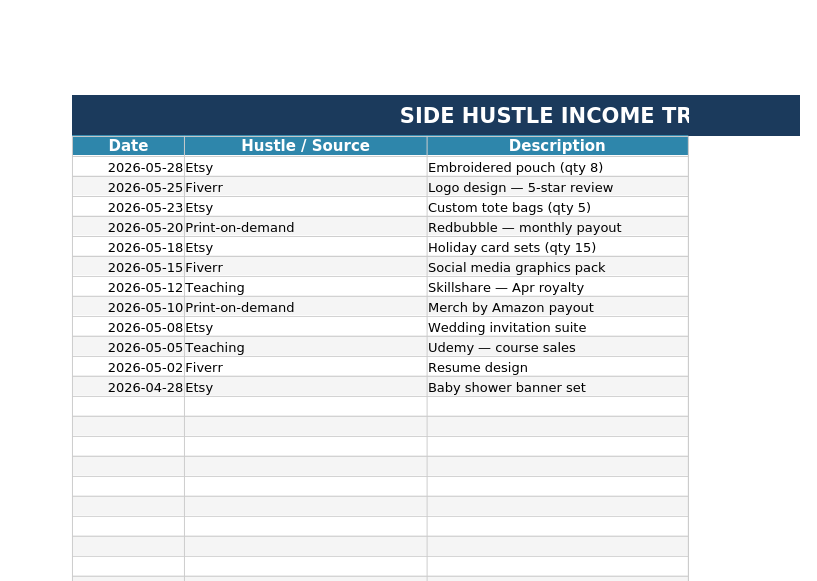
If you want to skip building a system from scratch, the Side Hustle Income Tracker template at smallbizfinancehq.com/templates is built specifically for this. For $12, you get a ready-to-use spreadsheet that organizes income by client and date, tracks deductible expense categories (including home office, mileage, and software), and runs a live estimate of your SE tax and total tax liability as you update it. It is the practical companion to everything covered in this post, and it will be worth considerably more than $12 the first time you sit down with your accountant.
What the Template Looks Like
Here is a preview of the Side Hustle Income Tracker with sample data filled in:
The Bottom Line
Side hustle taxes are not complicated once you understand the core mechanics: the $400 filing threshold, the 15.3% self-employment tax rate, the deductions you are entitled to claim, and the quarterly payment schedule the IRS expects. The mistake most people make is treating tax prep as a once-a-year event rather than an ongoing habit. Track your income and expenses consistently, estimate what you owe each quarter, and you will never face a surprise tax bill you are unprepared for.