Learn how to write a professional invoice with every required field, smart payment terms, and late fee strategies that help small businesses get paid faster.
How to Write a Professional Invoice That Gets Paid Faster
Most unpaid invoices are not ignored because clients are dishonest. They are ignored because the invoice itself gave the client no reason to act. Learning how to write a professional invoice means understanding that every field, every number, and every line of text either speeds up payment or quietly delays it.
Key Takeaways
- Invoices with specific due dates (such as "Due by March 15, 2025") get paid up to 3x faster than invoices that say "Net 30"
- Including an itemized breakdown reduces payment disputes by giving clients a clear record of what they approved
- Late fee clauses increase on-time payment rates by roughly 20%, even when the fee is never actually charged
- Freelancers and small business owners lose an average of $50,000 in unpaid invoices over a career, often from preventable errors
- Adding a personal "thank you" line to an invoice increases payment speed, according to research from FreshBooks
What a Professional Invoice Actually Is
An invoice is a legally binding request for payment. It documents the transaction between you and your client, establishes the amount owed, and sets the terms under which payment is expected. Courts have accepted invoices as evidence in small claims cases, which means every line carries real weight.
The difference between an invoice and a receipt is timing. An invoice comes before payment. A receipt confirms payment occurred. Confusing the two, or sending an informal email with a total at the bottom, can delay payment by days or weeks.
How to Write a Professional Invoice: Every Field That Belongs
1. Your Business Name, Logo, and Contact Information
Put your name, business name, address, phone number, and email at the top. If you have a logo, use it. Clients process visual information first, and a branded header signals that this is a formal financial document, not a casual note.
In practice, a client receiving an invoice from "Bright Line Design" with a professional logo is far less likely to push it to the bottom of the pile than one receiving an email that says "here is what you owe me."
2. Client's Name and Billing Address
This sounds obvious, but many invoices are delayed because they were sent to the wrong contact. Always address the invoice to the person or department responsible for approving payment, not just whoever you worked with on the project.
For larger clients, this often means the accounts payable department, not your day-to-day contact. Confirm this before you send.
3. A Unique Invoice Number
Every invoice needs a sequential number. Invoice #1001, Invoice #1002, and so on. This gives both you and your client a reference point for any communication about that specific payment.
Without an invoice number, a client saying "I have a question about your invoice" forces you to dig through emails to figure out which one they mean. That friction adds up.
4. Invoice Date and Due Date
The invoice date is the day you sent it. The due date is the day payment is expected. Both fields are required.
Here is why that matters: an invoice that says "Net 30" with no specific date forces the client to calculate the due date themselves. An invoice that says "Due by April 10, 2025" requires nothing from them. Remove friction wherever you can.
5. Itemized Description of Services or Products
List every service or product separately with a description, quantity, unit price, and line total. Do not lump everything into one line that says "consulting services, $3,500."
Itemization protects you legally and practically. When a client questions a charge, you have documentation. When a client approves an invoice with a clear breakdown, they are far less likely to dispute it later.
6. Subtotal, Taxes, and Total Amount Due
Show the math. List the subtotal before taxes, any applicable sales tax or VAT as a separate line, and then the total in bold. Make the total the most visually prominent number on the page.
If you offer a discount, show it as a line item too. Clients appreciate transparency, and it reduces questions.
7. Accepted Payment Methods
Specify exactly how you accept payment. Bank transfer, credit card, PayPal, check, or whatever applies to your business. Include your bank details or payment link directly on the invoice.
Leaving this out is one of the most common reasons invoices get delayed. Clients who have to email you to ask how to pay will often put that task off for days.
8. Late Fee Policy
State your late fee policy clearly. A simple line like "Invoices unpaid after 30 days are subject to a 1.5% monthly late fee" is enough. You do not need to be aggressive about it.
The key distinction is that the presence of a late fee clause changes behavior, even when clients never intend to pay late. It signals that you run a serious operation with financial policies, and that signal alone accelerates payment.
The Psychology of Payment Terms
How you phrase your payment terms has a measurable effect on when you get paid.
"Net 30" is standard, but it is also easy to ignore. It implies a 30-day window and no urgency. Rephrasing to "Payment due within 30 days of receipt, by [specific date]" adds a concrete deadline that the human brain responds to differently.
Early Payment Discounts
Offering a small discount for fast payment works for higher-value invoices. A common structure is "2/10 Net 30," which means the client gets a 2% discount if they pay within 10 days. On a $5,000 invoice, that is a $100 incentive.
This strategy makes more sense for B2B invoices than for consumer-facing ones. For a freelancer billing $500, the math rarely justifies it.
Shorter Default Terms
The industry default of Net 30 is not a rule. Many successful freelancers and small businesses use Net 14 or even Net 7 as their standard terms. Clients who object will tell you. Most will not.
A graphic designer who switches from Net 30 to Net 14 effectively cuts average payment time in half without losing clients.
A Real-World Example: How One Bad Invoice Cost $2,800
Consider this scenario. Marcus Chen runs a small video production company called Canopy Films in Austin, Texas. After completing a $2,800 brand video for a local restaurant group, he sent an invoice via email with a total, his Venmo handle, and no due date.
Three weeks passed with no payment. When Marcus followed up, the client said they had flagged the email to deal with later and genuinely forgotten. No dispute, no bad intent, just friction and no deadline.
After that experience, Marcus redesigned his invoice template. He added a specific due date 14 days out, listed each deliverable separately, included his bank transfer details and a PayPal link, and added a late fee clause for any balance unpaid after 30 days. His next six invoices were all paid within 10 days.
The invoice itself was the problem, not the client.
Late Fee Strategies That Actually Work
A 1.5% monthly late fee is the most common structure for service businesses and is widely enforceable in U.S. jurisdictions. That equals 18% annually, which is enough to motivate payment without feeling punitive.
Before Charging the Fee
Always send a reminder email 3 to 5 days before the due date. Keep it friendly and professional. Something like, "Just a quick heads-up that invoice #1042 for $1,200 is due on Friday, April 12. Please let me know if you have any questions."
This one step catches most slow payers before they technically become late, which saves the awkward conversation about fees entirely.
When to Actually Enforce the Fee
Enforce late fees selectively. For a long-term client who is occasionally slow, a reminder is usually enough. For new clients or one-off projects, enforce the fee as written. Letting it slide consistently teaches clients that your policies are suggestions, not terms.
How to Write a Professional Invoice: Formatting and Delivery Tips
Use a Clean, Readable Layout
White space matters. An invoice that is visually crowded looks difficult to deal with and easy to postpone. Use clear section headers, consistent fonts, and enough margin space that the document feels easy to read.
Send your invoice as a PDF, not a Word document or editable file. A PDF cannot be accidentally modified, and it renders correctly on any device.
Send Immediately After Completing Work
Invoice the moment work is delivered, not at the end of the month. The psychological connection between completed work and requested payment is strongest when the invoice arrives the same day as the deliverable.
Waiting two weeks to send an invoice signals that you are not particularly urgent about being paid. Clients read that signal accurately.
Follow Up on a Schedule
Send a reminder when the invoice is 3 days from due, another on the due date, and a final notice 7 days after if still unpaid. Keep every message professional. Most late payments are resolved by the second reminder without any conflict.
Save Time With a Pre-Built Professional Invoice Template
Everything covered in this post, from proper field structure to payment terms language and late fee clauses, takes real time to set up from scratch. If you want a ready-to-use document that already includes every element covered here, the Professional Invoice Template available for $9 on Gumroad is built specifically for freelancers and small business owners.
It includes all required fields, clean formatting designed to look credible on any screen, and customizable payment terms language you can adapt to your business in minutes. For less than the cost of a lunch, it removes the setup work entirely.
What the Template Looks Like
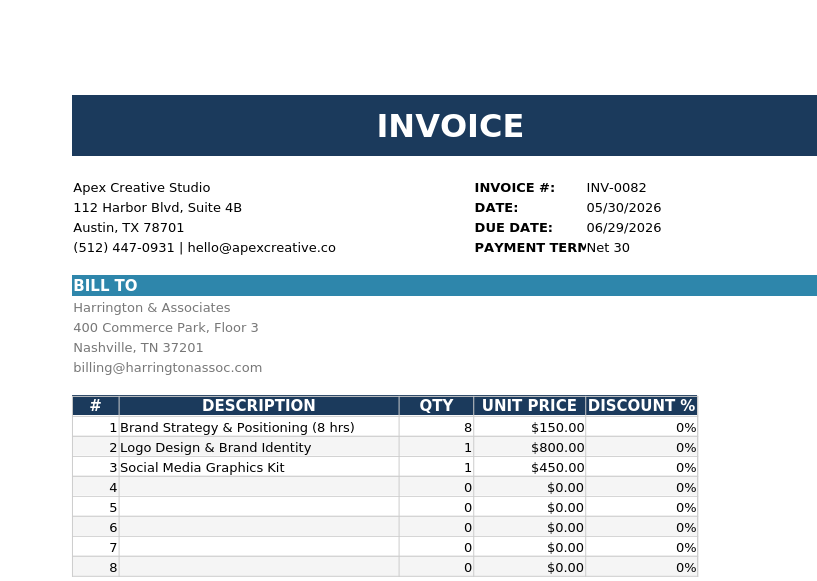
Here is a preview of the Professional Invoice Template with sample data filled in:
The Bottom Line
A professional invoice is not just a payment request. It is a document that communicates your credibility, sets clear expectations, and removes every obstacle between your client and the act of paying you. The businesses that get paid fastest are not necessarily the ones with the most forgiving clients. They are the ones whose invoices make payment the obvious next step. Apply every field and strategy covered here consistently, and late payments will become the exception rather than your normal experience.