Learn how to make money as a content creator by tracking ad revenue, sponsorships, affiliates, and digital products across every platform you use.
Content Creator Income: How to Track and Grow Revenue Across Every Platform
Most content creators are earning money from four or five different sources simultaneously and have no clear picture of which one is actually working. That disconnect is where profit leaks. Understanding how to make money as a content creator is only half the job. The other half is knowing exactly where that money comes from, what it costs you to earn it, and how to report it correctly when taxes are due.
Key Takeaways
- YouTube pays between $2 and $10 per 1,000 views (CPM), but actual creator earnings after Google's 45% cut average $3 to $5 RPM for most niches
- Sponsored content rates for mid-tier creators (50,000 to 500,000 followers) typically range from $500 to $10,000 per post, depending on niche and engagement rate
- Affiliate marketing conversion rates on creator content average 1% to 3%, meaning traffic volume directly determines income potential
- Digital products carry gross margins of 85% to 95%, making them the highest-margin revenue stream available to most creators
- The IRS requires self-employed creators to pay quarterly estimated taxes once they expect to owe more than $1,000 in a given tax year
Why Revenue Tracking Is a Business Skill, Not an Optional Extra
Content creation became a legitimate industry faster than most creators developed the financial habits to match. A creator pulling $4,000 a month from YouTube, a brand deal, and an affiliate program is running a small media business whether or not they treat it like one.
The problem is that platforms report income differently, pay on different schedules, and use different metrics. YouTube measures RPM. Sponsorship income arrives as lump-sum payments. Affiliate networks report in clicks, conversions, and commissions. Without a single system to consolidate those numbers, it is nearly impossible to make smart decisions about where to focus your time.
The 5 Core Monetization Streams for Content Creators
1. Platform Ad Revenue
Ad revenue is typically the first income source creators unlock, but it is often the least predictable. YouTube, TikTok, Facebook, and podcast networks all pay creators a share of ad revenue based on impressions, clicks, or CPM rates.
YouTube's Partner Program pays creators roughly 55% of ad revenue generated on their content. In practice, RPM (revenue per mille, or per 1,000 views) ranges widely. A personal finance channel might earn $12 to $20 RPM. A gaming channel might earn $2 to $4 RPM. Niche matters enormously here.
Tracking tip: Pull RPM and total estimated revenue monthly from YouTube Studio or your podcast host's analytics dashboard. Record it in one place alongside your view count so you can spot trends over time.
2. Brand Sponsorships and Paid Partnerships
Sponsorships represent the fastest path to significant income for creators with engaged audiences. A creator does not need millions of followers to earn serious money here. Micro-influencers with 10,000 to 50,000 highly engaged followers in a specific niche routinely command $300 to $2,000 per post.
The key distinction between a strong sponsorship deal and a weak one is not the flat fee. It is the rate relative to your engagement and deliverables. A $5,000 deal that requires three posts, two story sets, and a 60-day exclusivity clause is often worse than a $3,000 deal for a single dedicated video.
Always negotiate usage rights, exclusivity periods, and revision rounds in writing before accepting payment.
3. Affiliate Marketing
Affiliate marketing pays you a commission when someone purchases a product through your unique tracking link. Commission rates vary significantly: Amazon Associates pays 1% to 10% depending on category, while software affiliate programs frequently pay 20% to 40% of a recurring subscription.
The math on affiliates rewards consistency over virality. A creator with a library of 200 evergreen YouTube videos or blog posts can earn reliable passive affiliate income month after month because old content keeps driving clicks. One viral video is unpredictable. A deep catalog is an asset.
Track affiliate income by program, not just by total. Knowing that your Squarespace affiliate link generates $800 a month while your Amazon links generate $40 tells you exactly where to direct your audience in future content.
4. Digital Products
Digital products are where creator income becomes truly scalable. An ebook, online course, Lightroom preset pack, or downloadable template costs roughly the same to produce whether you sell 10 copies or 10,000.
Gross margins on digital products typically run 85% to 95% once you subtract platform fees (Gumroad, Teachable, and similar platforms charge 5% to 10%). Compare that to a physical product or service business running 40% to 60% margins and the advantage is obvious.
Here is why that matters: a creator earning $2,000 a month from digital products is keeping roughly $1,800 of that. A creator earning $2,000 from ad revenue has no direct cost control over whether that number goes up or down.
5. Memberships and Subscriptions
Platforms like Patreon, Substack, and YouTube Memberships allow creators to generate recurring monthly revenue from their most loyal audience members. Recurring income is more valuable than one-time income at every comparable dollar amount because it is predictable.
A creator with 300 Patreon members paying $10 per month earns $3,000 in baseline monthly income before any other revenue stream fires. That predictability changes how you plan, budget, and invest back into your content.
Patreon takes 5% to 12% of monthly earnings depending on your plan tier. Factor that into your net calculations when comparing it to direct subscription options like a Substack paid newsletter.
How to See Which Platform Is Actually Performing
Build a Unified Monthly Revenue Report
Logging into six dashboards and mentally adding up numbers is not a financial system. You need one consolidated view that shows, at a glance, how much each revenue stream earned in a given month and how that compares to the prior month.
At minimum, your monthly revenue report should capture: gross income by source, platform fees deducted, net income by source, and total net income for the month. That is four columns. It takes 20 minutes to update once you build the habit.
Apply a Revenue-per-Hour Framework
Not all income is equal when you account for the time required to generate it. A $2,000 sponsored post that takes 8 hours to produce (brief, filming, editing, posting, reporting) pays $250 per hour. A $500 affiliate commission earned from a video you made 18 months ago cost you zero hours this month.
Tracking revenue per hour by stream shows you where your time investment is generating the best return. Most creators discover their digital products and affiliates massively outperform their hourly rates on ad revenue.
A Real Example: How Priya Redefined Her Revenue Mix
Priya runs a personal finance YouTube channel called "Rupees to Riches" with 85,000 subscribers. In January, her total revenue was $6,200: $1,800 from YouTube ads, $2,500 from a single brand deal, $700 from affiliate links, and $1,200 from a budgeting spreadsheet she sells for $29 on Gumroad.
When Priya mapped her hours against each stream, she realized she spent 30 hours on the brand deal (research, filming, revisions, compliance review) for an effective rate of $83 per hour. Her Gumroad spreadsheet required zero hours in January and generated $1,200.
She shifted her focus to creating two more digital products in Q1. By March, her digital product revenue had grown to $3,400 per month, and her total income crossed $8,000 for the first time without adding any new brand deal work.
Tax Implications Every Creator Needs to Understand
Self-Employment Tax and Quarterly Payments
Content creator income is self-employment income. That means you owe both the employee and employer portions of Social Security and Medicare taxes, which adds up to 15.3% on top of ordinary income tax. For a creator earning $60,000 net annually, that self-employment tax alone approaches $9,200.
The IRS expects quarterly estimated tax payments if you anticipate owing more than $1,000 for the year. Missing those deadlines triggers underpayment penalties. Most tax professionals recommend setting aside 25% to 30% of every payment you receive as a baseline.
Deductible Business Expenses
The flip side of self-employment tax is that business expenses are deductible. Camera equipment, editing software subscriptions, a dedicated home office space (calculated using the IRS simplified method at $5 per square foot up to 300 square feet), contractor payments, and platform fees all reduce your taxable income.
Keep records for every deduction. A receipt-tracking app or a dedicated business bank account creates a clean paper trail that protects you if the IRS ever questions a deduction.
1099 Reporting Thresholds
Most platforms issue a 1099-NDA or 1099-K when your earnings cross $600 in a calendar year. You are legally required to report that income whether or not you receive a form. Affiliate networks, brand deal payments routed through agencies, and Patreon payouts are all taxable regardless of platform.
Track All of This Without Building It From Scratch
If consolidating six income streams, calculating net revenue by platform, and preparing clean numbers for your accountant sounds like a full afternoon of work every month, there is a faster way to set it up.
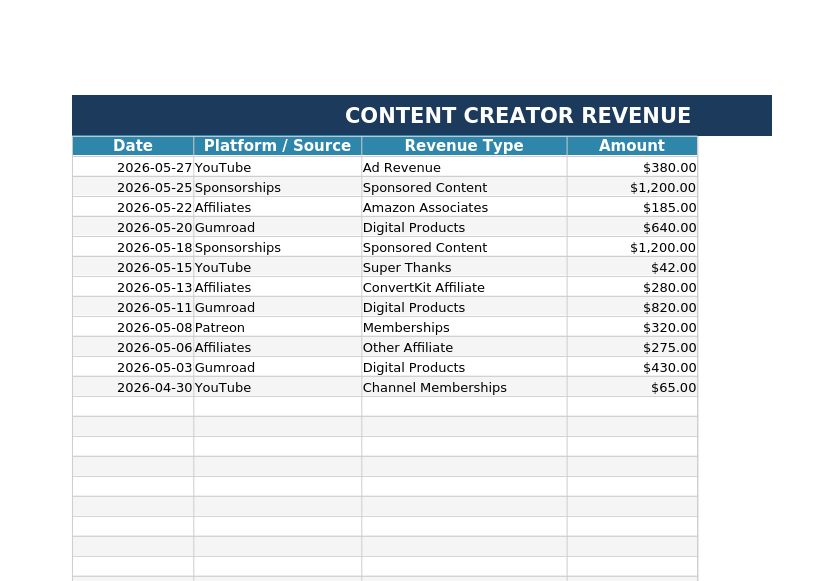
The Content Creator Revenue Tracker, available at smallbizfinancehq.com/templates for $15, is a pre-built spreadsheet that organizes everything covered in this article. It captures monthly income by stream, calculates platform fees and net revenue automatically, tracks year-to-date totals, and includes a dedicated section for estimated tax tracking. For creators juggling multiple platforms and income sources, it eliminates the setup work so you can spend your time on content instead.
What the Template Looks Like
Here is a preview of the Content Creator Revenue Tracker with sample data filled in:
The Bottom Line
Learning how to make money as a content creator is a starting point, not a finish line. The creators who build sustainable, growing income businesses are the ones who treat revenue tracking as a core professional habit, not an afterthought. Knowing your numbers by stream, understanding your tax obligations, and evaluating each platform on net return rather than gross income are the practices that separate a content hobby from a content business. Build those habits now, before the complexity of your income outpaces your ability to manage it.