Learn how much to charge as a freelancer using real math. Factor in self-employment tax, overhead, and non-billable hours to set rates that actually pay you.
How Much Should You Charge as a Freelancer? A Data-Backed Answer
Most freelancers set their rates by guessing, Googling competitors, or simply charging what a client first offered them. All three methods leave money on the table. Knowing how much to charge as a freelancer requires working backward from the income you actually need, then layering in taxes, overhead, and the reality that not every hour you work is a billable one.
Key Takeaways
- Self-employment tax runs 15.3% on net earnings up to $160,200 (2024 IRS threshold), which most freelancers forget to factor into their rates.
- The average freelancer bills only 50 to 60% of total working hours, meaning a 40-hour week generates roughly 20 to 24 billable hours.
- Freelance graphic designers earn a median hourly rate of $25 to $75, while software developers commonly charge $75 to $175 per hour, per Upwork and Bureau of Labor Statistics data.
- A freelancer who wants to net $80,000 annually needs to bill closer to $130,000 to cover taxes, overhead, and unpaid time.
- Setting a rate based on market price alone, without knowing your cost floor, is how profitable-looking freelance businesses end up cash-flow negative.
Why Most Freelance Rates Are Set Wrong
Freelancers typically anchor their rates to two flawed reference points: what the market charges or what they earned as an employee. Neither accounts for the true cost of running a one-person business.
When you were an employee earning $60,000 per year, your employer was quietly covering payroll taxes, health insurance, office expenses, software subscriptions, and paid time off. As a freelancer, every one of those costs falls on you. Ignoring them means your $75 hourly rate may actually net you closer to $35 after expenses and taxes.
Step 1: Start With Your Target Annual Income
The first number to establish is how much you want to take home after taxes. This is your net income target, not your billing target.
For this example, meet Jordan Calloway, a freelance content strategist based in Austin, Texas. Jordan wants to take home $75,000 this year after taxes. That is the starting point, not the ending point.
Calculate Your Gross Income Requirement
To find out how much Jordan needs to bill before taxes, work backward using her effective tax rate. With self-employment tax at 15.3% and a federal income tax rate of approximately 22%, Jordan's combined tax burden is roughly 30% to 35% on her freelance income after the SE tax deduction.
Using a 32% combined effective rate as a reasonable estimate:
Target gross income = $75,000 / (1 - 0.32) = $110,294
Jordan needs to earn about $110,000 in gross freelance income just to net $75,000.
Step 2: Add Overhead and Business Expenses
Gross income before taxes is not the same as your billing target. You still need to account for what it costs to operate your business.
Jordan's annual business expenses include:
- Health insurance premiums: $4,800
- Accounting software and tools: $1,200
- Professional development and courses: $1,500
- Home office and equipment: $1,800
- Marketing and website costs: $1,000
That totals $10,300 in annual overhead. Add that to the $110,294 gross income requirement.
Total revenue needed = $110,294 + $10,300 = $120,594
Jordan now knows she needs to generate roughly $121,000 in client revenue to reach her $75,000 take-home goal.
Step 3: Account for Non-Billable Hours
This is the step where most freelancers dramatically underestimate their required rate. Not every working hour generates client revenue.
Think about what a typical freelance week actually looks like. Jordan works about 45 hours per week. Of those, she spends roughly:
- 8 hours on business development and proposals
- 4 hours on invoicing, admin, and client emails
- 3 hours on professional development
That leaves approximately 30 billable hours per week, not 45. Over 48 working weeks per year (accounting for vacation and sick time), Jordan has about 1,440 billable hours annually.
Calculate Your Billable Hours
The formula is straightforward:
(Weekly working hours - Non-billable hours) x Working weeks per year = Total annual billable hours
For Jordan: (45 - 15) x 48 = 1,440 billable hours
Step 4: Calculate Your Minimum Hourly Rate
Now divide total revenue needed by total billable hours.
Minimum hourly rate = $120,594 / 1,440 = $83.74 per hour
Jordan's floor rate is $84 per hour. Charging less than that means she will not hit her income goal regardless of how busy she stays.
Here is why that matters. If Jordan had simply looked up average content strategist rates on a freelance marketplace and picked $65 per hour, she would have worked full weeks and still fallen $27,000 short of her income target.
Step 5: Apply a Profit Margin
Your floor rate covers costs. It does not build a business. A profit margin on top of your floor rate creates room for slow months, business investment, and actual savings.
Most small business advisors recommend a 20% to 30% profit margin for service-based freelancers. Applying a 25% margin to Jordan's floor rate:
Final rate = $83.74 x 1.25 = $104.68 per hour
Jordan should charge approximately $105 per hour as her standard rate.
How Much to Charge as a Freelancer by Specialty
Your math sets the floor. The market sets the ceiling. The goal is to find a rate that satisfies both.
Below are current market rate benchmarks based on Upwork, the Bureau of Labor Statistics, and industry survey data from platforms including Fiverr Pro and Toptal.
Freelance Rate Benchmarks by Field (2024)
Copywriters and Content Writers Entry-level: $25 to $45/hour Mid-level: $50 to $85/hour Senior/specialist: $90 to $150/hour
Graphic and Brand Designers Entry-level: $25 to $50/hour Mid-level: $55 to $90/hour Senior/specialist: $95 to $175/hour
Web Developers (Front End) Entry-level: $40 to $70/hour Mid-level: $75 to $120/hour Senior/specialist: $125 to $200+/hour
Social Media Managers Entry-level: $20 to $40/hour Mid-level: $45 to $75/hour Senior/specialist: $80 to $125/hour
Financial Consultants and Bookkeepers Entry-level: $30 to $55/hour Mid-level: $60 to $100/hour Senior/specialist: $110 to $200/hour
Virtual Assistants Entry-level: $15 to $25/hour Mid-level: $28 to $50/hour Senior/specialist: $55 to $85/hour
If your calculated floor rate is higher than the market ceiling in your niche, you have two options: reduce overhead, or specialize into a higher-value segment where rates support your income target.
When to Charge Project Rates Instead of Hourly
Hourly billing caps your income at the number of hours you can sell. Project-based pricing breaks that ceiling.
A brand identity package that takes Jordan 15 hours at $105/hour earns $1,575. But if that deliverable is worth $4,000 to a client launching a product, she is leaving $2,425 on the table by billing hourly.
How to Convert Your Hourly Rate to Project Pricing
Estimate your hours for the project and multiply by your hourly rate, then add a 20% buffer for scope creep and revisions.
Project price = (Estimated hours x Hourly rate) x 1.20
For a project Jordan estimates at 20 hours: (20 x $105) x 1.20 = $2,520 minimum project rate
Use that as your floor. Then research what similar projects command in your market and price accordingly.
Adjusting Your Rate Over Time
Your rate is not a permanent fixture. It should increase annually to account for inflation, skill growth, and shifts in demand.
A practical rule: raise your rate by 5% to 10% per year for existing clients, and introduce the new rate immediately for any new clients. If you are booked out more than six weeks in advance, that is a reliable signal your current rate is too low.
Jordan, after two years, should be charging somewhere between $115 and $125 per hour based on this approach, without a single negotiation with existing clients.
Do the Math Once, Use It Every Time
If stepping through each calculation manually sounds tedious, it is because it is. One spreadsheet or template built around this framework saves hours of second-guessing every time you quote a new client.
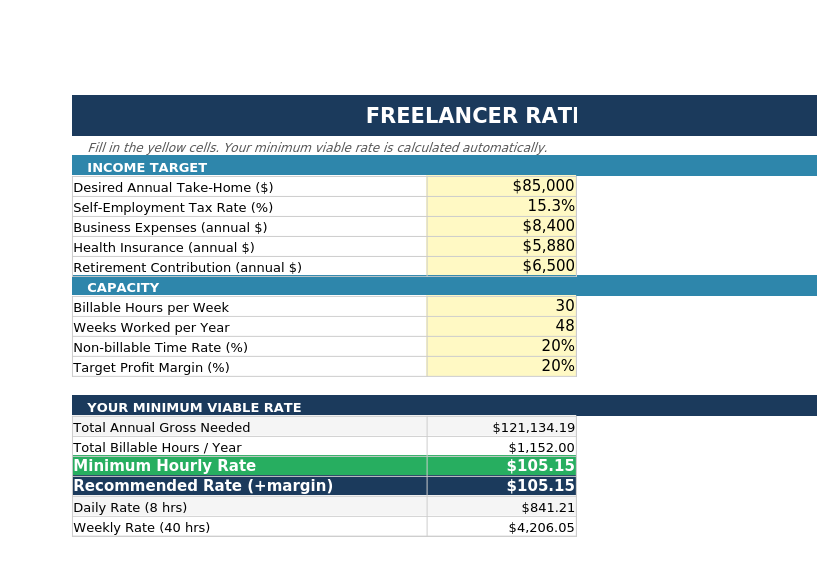
The Freelancer Rate Calculator at smallbizfinancehq.com/templates is built to run exactly this math for you. Enter your income goal, tax rate, overhead, and working hours, and it outputs your floor rate, target rate, and project pricing benchmarks automatically. At $9, it takes five minutes to use and eliminates the guesswork that causes most freelancers to underprice their work from day one.
What the Template Looks Like
Here is a preview of the Freelancer Rate Calculator with sample data filled in:
The Bottom Line
Setting your freelance rate based on gut feel or competitor pricing alone is a reliable path to underearning. The right approach is to calculate your income floor first, then check it against market benchmarks to ensure the number is both sustainable and competitive. A freelancer who wants to net $75,000 after taxes will typically need to bill north of $120,000 once taxes, overhead, and non-billable hours are accounted for. Know your number before you quote your next client.