Learn how Etsy seller fees eat into your profit margin, from listing to transaction costs, and how to price your products to actually make money.
Etsy Seller Fees Explained: How to Calculate Your Real Profit Margin
Etsy seller fees and profit margin calculations trip up thousands of shop owners every year. A product that sells for $30 can net you less than $18 after fees, and that gap does not shrink on its own. If you are pricing based on cost of materials alone, you are likely leaving money on the table, or worse, actively losing it. This guide breaks down every fee Etsy charges, shows you the math on a real scenario, and explains how to price so your shop actually earns a profit.
Key Takeaways
- Etsy charges a $0.20 listing fee per item, renewed automatically every time a product sells or expires after four months.
- The transaction fee is 6.5% of the total sale price, including the shipping cost you charge the buyer.
- Payment processing fees through Etsy Payments run 3% plus $0.25 per transaction for U.S. sellers, though rates vary by country.
- Offsite Ads fees can reach 15% of the sale price for sellers under $10,000 in annual revenue, applied automatically to purchases driven by Etsy's advertising.
- A $30 item with $5 shipping can net as little as $17.21 after all Etsy fees, before you subtract your materials, labor, and packaging costs.
The Full Breakdown of Etsy Seller Fees
Etsy's fee structure has four main components. Each one is calculated slightly differently, and missing even one of them distorts your margin entirely.
1. Listing Fee: $0.20 Per Item
Every time you publish or renew a listing on Etsy, you pay $0.20. That fee applies whether the item sells or not. If your listing expires after four months without selling, Etsy charges $0.20 to renew it. When a multi-quantity listing sells one unit, a new listing is automatically created for the remaining quantity, and you are charged another $0.20.
For high-volume sellers, these fees compound quickly. A seller with 200 active listings pays $40 every four months just to maintain visibility.
2. Transaction Fee: 6.5% of the Total Sale
The transaction fee is where most sellers underestimate their costs. Etsy charges 6.5% not just on the item price but on the full amount the buyer pays, including the shipping fee you charge. If you list an item at $30 and charge $5 for shipping, Etsy calculates 6.5% on $35, which comes to $2.28.
This distinction matters enormously for sellers who offer "free shipping" by baking the shipping cost into their item price. The transaction fee math stays the same either way.
3. Payment Processing Fee: 3% Plus $0.25 Per Transaction
U.S. sellers using Etsy Payments, which is required in most countries, pay 3% of the total transaction amount plus a flat $0.25 per order. On a $35 sale (item plus shipping), the payment processing fee is $1.05 plus $0.25, totaling $1.30.
International sellers pay different rates. UK sellers pay 4% plus £0.20. Canadian sellers pay 3% plus C$0.25. These differences are worth factoring in if you sell across borders.
4. Offsite Ads Fee: 12% to 15% of the Sale Price
This one catches sellers off guard. Etsy automatically enrolls all shops in its Offsite Ads program, which promotes your listings on platforms like Google, Facebook, and Pinterest. If a buyer clicks one of those ads and purchases within 30 days, Etsy charges you a fee.
Sellers who made less than $10,000 on Etsy in the previous 12 months pay 15% of the order total. Sellers above $10,000 pay 12% and can opt out of the program. You cannot opt out if you are under the threshold. On a $35 order, a 15% Offsite Ads fee adds $5.25 to your cost structure, applied selectively but often without warning.
Real Example: How a $30 Item Nets Under $18
Meet Clara, who runs a shop called Fern & Thread on Etsy selling hand-embroidered linen pouches. Her most popular item is priced at $30, and she charges $5 for shipping. Here is what the numbers look like on a single sale driven by Offsite Ads.
Sale total (item + shipping): $35.00
| Fee | Calculation | Amount |
|---|---|---|
| Listing fee | Flat rate | $0.20 |
| Transaction fee | 6.5% of $35 | $2.28 |
| Payment processing | 3% of $35 + $0.25 | $1.30 |
| Offsite Ads fee | 15% of $35 | $5.25 |
| Total Etsy fees | $9.03 |
After fees, Clara has $25.97 remaining. But that is not profit. Her materials cost $5.50 per pouch, shipping supplies and postage run $4.75, and she estimates her labor at roughly $3.00 per item. Her total variable costs are $13.25.
Net profit: $25.97 minus $13.25 equals $12.72.
On a $30 item, Clara is netting $12.72, a margin of about 42% when you only count variable costs. But if she allocates even a portion of her fixed costs (Etsy subscription, photography equipment, workspace) to each unit, that margin compresses further.
How Etsy Seller Fees Affect Your Profit Margin at Different Price Points
The percentage impact of Etsy fees shrinks as your item price rises, which is why low-priced items are particularly dangerous on the platform.
Low-Ticket Items Under $15
At a $12 sale with $4 shipping, the $0.20 listing fee alone represents 1.25% of your revenue. Add a 15% Offsite Ads fee and your effective fee rate can exceed 27% of the sale price. Selling cheap items on Etsy without extremely low production costs is a fast path to thin or negative margins.
Mid-Range Items Between $25 and $75
This is where most Etsy sellers operate. The math is workable with careful pricing, but only if you account for all four fee categories before setting your price, not after.
Premium Items Over $100
Higher-priced handmade goods benefit from economies of scale in the fee structure. The $0.20 listing fee becomes negligible. Even the Offsite Ads fee, while still significant in dollar terms, represents a smaller share of a healthy margin. Sellers who can position their products in the $100 to $300 range often find Etsy more profitable per transaction.
How to Price for Actual Profit on Etsy
Pricing backwards from your target profit is the most reliable method. Here is the framework.
Step 1: Add Up Your True Costs
Start with direct costs: materials, packaging, postage, and any labor cost you assign yourself. Be honest about your time. If you spend 45 minutes making a product, you are working for less than minimum wage if you price at $20.
Step 2: Estimate Your Etsy Fee Load
Calculate your expected fees as a percentage of your total order value. If Offsite Ads apply frequently to your shop, budget for 15% on top of your base fee structure. In practice, a conservative estimate for most sellers is 25% to 28% of total order revenue going to Etsy fees once you include payment processing and Offsite Ads.
Step 3: Set a Target Profit Margin
Decide what margin you need before you name a price. A 40% gross margin on handmade goods is reasonable. A 25% margin leaves little room for unexpected costs or slow periods.
Step 4: Work the Math Forward
If your total costs (materials, labor, packaging, postage) are $14.00 and you need a 40% gross margin, your minimum viable price is $14.00 divided by (1 minus 0.40), which equals $23.33. Then check whether your Etsy fee load at that price still leaves you with 40%. If not, raise the price until the math holds.
Etsy Seller Fees and Profit Margin: Common Mistakes to Avoid
Forgetting That Shipping Fees Are Taxed Too
The transaction fee applies to the full buyer-paid amount, including shipping. Charging $8 for shipping on a $30 item means Etsy charges 6.5% on $38. Sellers who forget this overprice shipping and underprice their product, or miscalculate margin entirely.
Treating Offsite Ads as Optional
Until you hit $10,000 in Etsy sales, the program is mandatory. Price every item as if an Offsite Ads fee might apply, because statistically, for a well-ranked listing, it often will.
Ignoring the Etsy Plus Subscription
Etsy Plus costs $10 per month and includes listing credits and other perks. For low-volume shops, this fee can represent a meaningful percentage of monthly revenue. Factor it in.
Save Time with a Purpose-Built Calculator
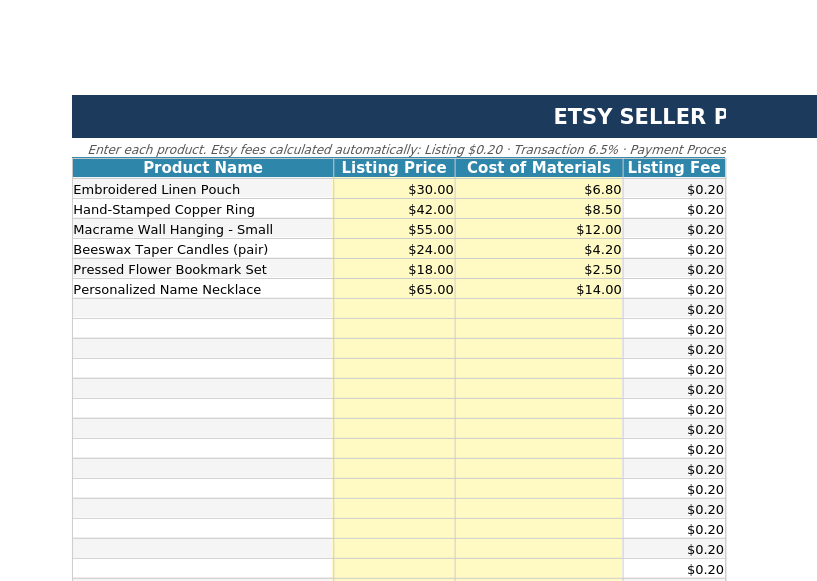
Running these numbers manually every time you price a new product is tedious, and one missed fee can quietly erode months of margin. The Etsy Seller Profit Calculator template at Small Business Finance HQ ($14) was built to do exactly what this post walked you through, automatically. Enter your item price, shipping, materials, labor, and it calculates your net profit after every Etsy fee category, including Offsite Ads scenarios. It is the kind of tool that pays for itself the first time it stops you from pricing too low.
What the Template Looks Like
Here is a preview of the Etsy Seller Profit Calculator with sample data filled in:
The Bottom Line
Etsy is a powerful sales channel, but it is not a low-cost one. Between listing fees, a 6.5% transaction fee, payment processing, and potential Offsite Ads charges, sellers can easily see 25% or more of their revenue absorbed before a single production cost is counted. Pricing with intention, using real numbers across every fee category, is the difference between a profitable shop and a hobby that barely breaks even. The sellers who thrive on Etsy are not necessarily the most talented makers. They are the ones who understand their numbers.