Learn the 2025 IRS business mileage deduction rate, which trips qualify, how to handle mixed use, and how to keep records that survive an audit.
The IRS Business Mileage Deduction: What Qualifies and How to Track It
The business mileage deduction IRS rules let self-employed workers and business owners write off every qualifying mile they drive at a federally set rate. For 2025, that rate is 67 cents per mile, unchanged from the second half of 2023 and carried through 2024 into the current tax year. On 20,000 business miles, that is a $13,400 deduction. The math is straightforward, but the rules around what qualifies, what does not, and how to document everything are where most business owners stumble.
Key Takeaways
- The 2025 IRS standard mileage rate is 67 cents per mile for business use of a personal vehicle.
- Commuting from home to a regular workplace does not qualify as a business deduction, regardless of how far you drive.
- The IRS requires a contemporaneous mileage log that records the date, destination, business purpose, and miles driven for each trip.
- Self-employed individuals claim business mileage on Schedule C, while employees who use their own vehicle for work can no longer deduct unreimbursed mileage after the 2017 Tax Cuts and Jobs Act.
- Mixing personal and business use in the same vehicle is allowed, but only the business-use percentage is deductible, and the IRS scrutinizes any vehicle claimed at 100% business use.
What the IRS Business Mileage Deduction Actually Covers
The standard mileage rate exists to simplify what would otherwise be a complicated calculation. Instead of tracking actual fuel costs, depreciation, insurance, and maintenance, you multiply your qualifying miles by the IRS rate and deduct the result.
To use the standard mileage rate, you must choose it in the first year the vehicle is placed in service for business. If you switch to the actual expense method later, you can, but you cannot go back. The IRS outlines this in Publication 463.
The rate itself accounts for both variable costs like gas and oil changes, and a fixed depreciation component. For 2025, that built-in depreciation rate is 30 cents per mile, which matters if you ever sell the vehicle and need to calculate your adjusted basis.
Which Trips Qualify for the Business Mileage Deduction IRS Rules
Not every mile you drive for work is deductible. The IRS draws a firm line between business travel and commuting, and that distinction catches a lot of small business owners off guard.
Trips That Qualify
The following types of driving count as deductible business mileage:
- Driving from your office or home office to a client meeting
- Traveling between two business locations you operate
- Driving to pick up supplies, equipment, or inventory for your business
- Travel to a temporary work site (defined as a location expected to last less than one year)
- Driving to a bank, accountant, or attorney for business-related matters
If you run a landscaping business and drive from your home office to a client's property, that trip is deductible. The home office designation is key here. The IRS allows the home-to-first-stop deduction only when your home qualifies as your principal place of business.
Trips That Do Not Qualify
Commuting is the single biggest category of non-deductible driving. The IRS defines commuting as travel between your home and a regular or main workplace. It does not matter if your commute is 3 miles or 45 miles. It does not matter if you take a work call the entire way. The trip is personal.
Other non-deductible miles include personal errands run during a business trip, driving to a gym or coffee shop for personal use even if you occasionally conduct business there, and mileage reimbursed by an employer or client.
How to Handle Mixed Personal and Business Vehicle Use
Most self-employed business owners use one vehicle for both personal and business driving. The IRS permits this, but you can only deduct the business-use percentage of your total miles.
Here is how the calculation works. Suppose you drive 18,000 total miles in 2025. Of those, 11,700 are for qualifying business purposes. Your business-use percentage is 65%. At 67 cents per mile, your deduction is $7,839 (11,700 x $0.67).
Why 100% Business Use Is a Red Flag
Claiming a vehicle at 100% business use is one of the top audit triggers the IRS watches for. The IRS knows that almost no personal vehicle is used exclusively for business. If you do claim 100%, you need airtight documentation, a second personal vehicle you can point to, and a clear explanation of how you got to and from work.
In practice, claims above 80% business use tend to draw scrutiny. That does not mean you should artificially lower your percentage, but it does mean your records need to be precise.
A Real Example: How Maria's Bookkeeping Business Handles Mileage
Maria runs a sole proprietorship called Clarity Books out of her home in Austin, Texas. She visits six regular clients each week, drives to the bank every Friday, and picks up supplies at the office store about twice a month.
Over 12 months in 2025, Maria logs 14,200 business miles against a total of 21,500 miles driven. Her business-use percentage is 66%. Using the standard mileage rate, her deduction is $9,514 (14,200 x $0.67).
If Maria had not tracked those miles carefully and instead estimated at the end of the year, she might have underreported by 2,000 miles, costing her roughly $1,340 in deductions. She also has two trips in her log from February that she almost forgot: a drive to her accountant to discuss quarterly taxes and a trip to a networking event where she met two new clients. Both qualify.
Maria's situation illustrates why the habit of logging each trip the same day it happens is worth the two minutes it takes.
IRS-Proof Mileage Recordkeeping: What Your Log Needs to Include
The IRS requires contemporaneous records, meaning you document each trip close to the time it occurs, not at the end of the quarter or year. A mileage log reconstructed from memory after the fact will not hold up under audit.
What Each Entry Must Include
Every trip in your mileage log needs to capture these five elements:
- The date of the trip
- The starting point and destination
- The business purpose of the trip
- The odometer reading at the start and end, or the total miles driven
- The name of any client or business contact you were visiting
A simple spreadsheet, a dedicated mileage app, or a paper logbook all work. What matters is consistency and completeness.
The Odometer Method vs. App-Based Tracking
Manually recording odometer readings gives you the most defensible paper trail because it ties specific mileage figures to specific dates. Apps like MileIQ or Everlance automate GPS tracking and generate exportable reports, which also hold up well.
Whatever method you use, back up your records. The IRS can audit returns up to three years back in most cases, and up to six years if it suspects substantial underreporting. Your mileage log needs to survive that window.
The Business Mileage Deduction IRS Filing: Where It Goes on Your Return
Self-employed business owners report vehicle expenses, including standard mileage deductions, on Schedule C, Part II, Line 9. You will also need to complete Part IV of Schedule C (Information on Your Vehicle) if you are claiming any vehicle deduction.
Part IV asks whether you have written evidence to support your deduction, whether you have another vehicle available for personal use, and whether your vehicle was available for personal use during off-duty hours. These questions exist specifically to screen for inflated or fraudulent vehicle deductions.
If you operate as an S-corp or partnership and the business owns the vehicle, the deduction flows through the entity's return instead. Consult your tax advisor on the right treatment, especially if the vehicle is titled in your name but used exclusively for the business.
Save Time on Exactly This: A Mileage Tracker Built for Small Business Owners
If tracking mileage and business expenses still feels like a pile of loose receipts and forgotten trips, a structured template can fix that problem in one afternoon.
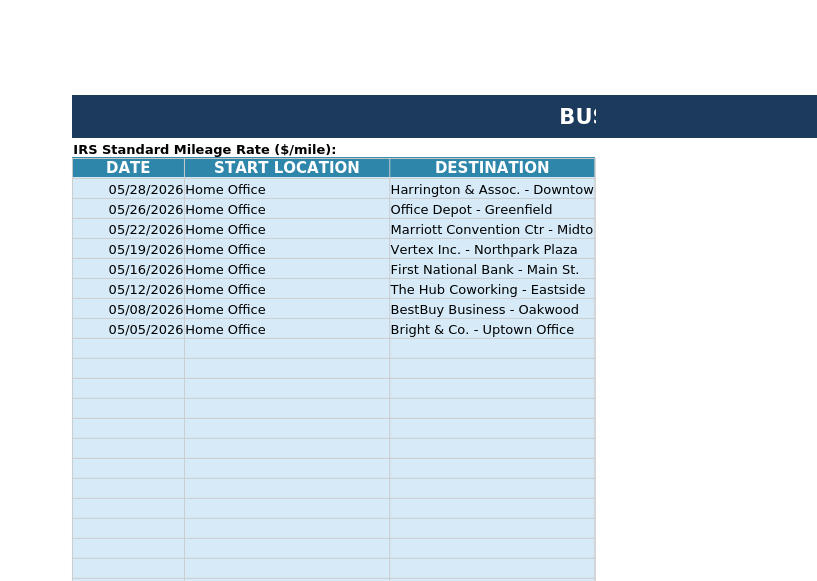
The Mileage and Expense Tracker template at Small Business Finance HQ is a $9 downloadable spreadsheet designed to log everything this article covers: trip dates, destinations, business purpose, odometer readings, and running totals. It does the mileage math automatically and keeps your records in the format the IRS expects.
If you drive regularly for your business and want to stop leaving deductions on the table, this is the tool to set up now, before April gets close.
What the Template Looks Like
Here is a preview of the Mileage & Expense Tracker with sample data filled in:
The Bottom Line
The IRS business mileage deduction is one of the most accessible write-offs available to self-employed workers, but it requires accurate, consistent recordkeeping to hold up under scrutiny. At 67 cents per mile in 2025, even modest business driving adds up to meaningful tax savings over a full year. The difference between a defensible deduction and a disallowed one almost always comes down to whether you logged the trip the day you took it.
This article is for informational purposes only and does not constitute tax advice. Consult a licensed tax professional for guidance specific to your situation.